Table Of Content
The next most frequent journal was the Journal of Autism and Developmental Disorders, representing 4% of the journal cohort. Analysis of Verbal Behavior and Behavioral Interventions each made up 3% of our journal cohort, and the remaining journals contributed 1%–2% each. Journals contributing less than 1% were grouped as “Other,” making up 16% of the total cohort. Within the cohort of study records, 48% of records had participants that were solely male, 45% were of mixed sex, and 4% of the publications had solely female participants.
Who provides ABA services?
As reported in other research, participants diagnosed solely with ASD were most often measured upon changes in cognition, language, and social skills and communication (Reichow et al., 2012). It is interesting that the mixed-diagnoses category was also commonly measured on language outcomes, but the most common outcome measure was problem behavior, at 31% of study records in the ABA Impact section. The results of the between-groups comparisons in this scoping review indicated that 23 comparison records compared intensive ABA (20–40 hr of intervention per week) to control or other interventions. Existing literature indicates that 30–40 intervention hours per week for children under the age of 6 results in greater improvements in cognition, language development, social skills, and more (Kovshoff et al., 2011; Reed et al., 2007b). That said, more recent large-scale analyses on children who received 12 months of ABA services indicated that increased intensity does not necessarily predict better outcomes (Department of Defense, 2020). In a meta-analysis completed by Rodgers et al. (2020), autism symptoms showed no statistically significant improvements with higher intensity EIBI treatments as opposed to lower intensity EIBI treatments.
CCD Design Characteristics
Look for providers that welcome your perspective and full participation in your child’s plan. Ask a range of people about the services provided, take both positive and negative comments, and then make a decision based on what will benefit your entire family. All Medicaid plans must cover treatments that are medically necessary for children under the age of 21. If a doctor prescribes ABA and says it is medically necessary for your child, Medicaid must cover the cost.
Treatment goals can include many different skill areas, such as:
A further study was excluded which utilized the CCD to reduce body weight and implemented weight criterions; this study was removed as weight is not a behavior, rather a by-product of other behavior(s) and possibly confounded by biology and other factors. Frequency of behavior was the dimension most often targeted (57.4 %) as opposed to more fine manipulations such as magnitude (23.6 %) and duration (5.1 %). Within the total 267 interventions, the type of target behavior varied widely across classifications with academic-related behaviors being the most frequent (19.0 %); see Table 3 for a full list of dimension and target behavior percentages. Comprehensive treatment, including ABT, refers to treatment of the multiple affected developmental domains, such as cognitive, communicative, social, emotional, and adaptive functioning. Maladaptive behaviors, such as noncompliance, tantrums, and stereotypical actions are also typically the focus of treatment (Maglione, 2012). Comprehensive ABT treatment may be referred to as adaptive behavior treatment or adaptive behavior treatment with protocol modification.
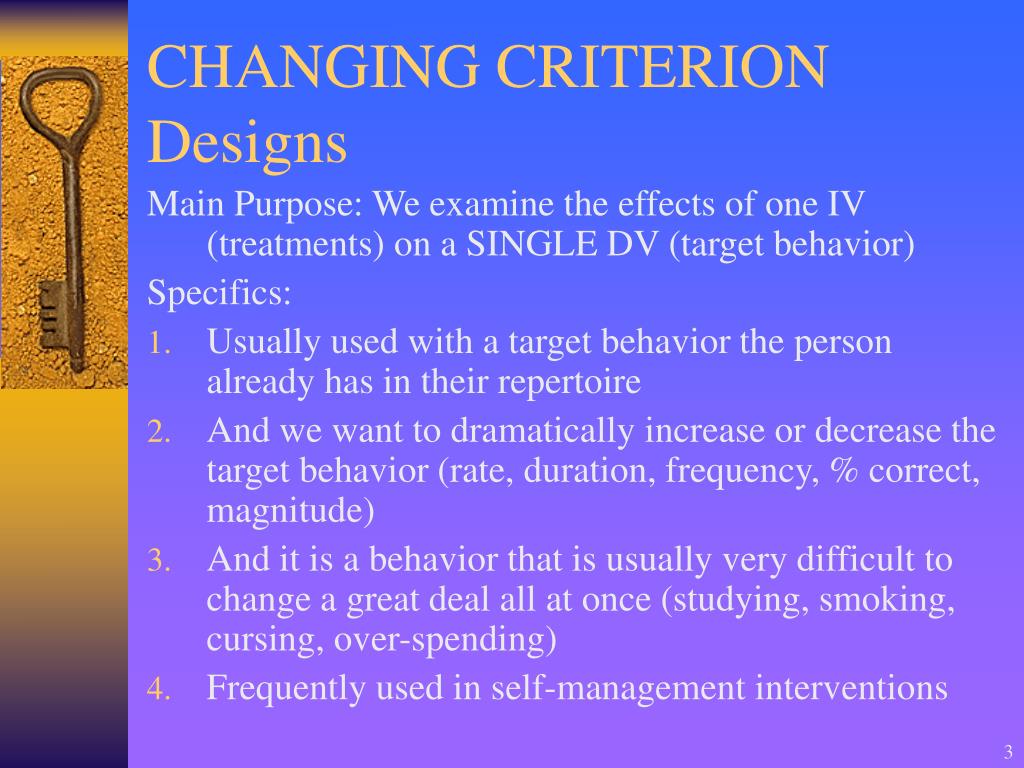
Also, the use of forced follow through to criterion may in some cases be beneficial in encouraging independent behavior change; however, we recommend clear documentation between forced versus independent responding. It is a flexible design that can be used with any population, on a diverse range of behaviors, in a variety of settings, while maintaining adequate experimental control. The CCD is particularly well suited for cultivating incremental changes in behavior that may otherwise be resistant to sizable, immediate changes (e.g., habits) or aversive (e.g., anxiety-provoking). Each graph with a CCD portion was coded as an A (i.e., intervention only), AB, ABA, ABAB, or other model type. Parametric variations such as B1, B2, B3 were condensed for coding purposes into the singular B.

This assessment should include confirmation of a diagnosis of ASD made by a licensed medical professional, licensed psychologist, or other qualified health care professional. The evaluation of motor, language, social, adaptive, and/or cognitive functions is important to understand the individual’s baseline status and potential for improvement (Maglione, 2012). In cases of mixed age (i.e. including subjects over 18 years of age) or mixed population (i.e., including typically developing subjects), studies were excluded if it was not possible to extract results for the target population separately.
Planning and Ongoing Assessment
Only a small amount of studies used both reinforcement and punishment without another intervention (10.1 %) and fewer studies used punishment alone (.7 %). Of the 196 interventions with contingent reinforcement, 167 (85.2 %) utilized fixed-ratio schedules (FR) and 29 used variable ratio (VR). All 61 interventions with contingent punishment implemented punishment on fixed-ratio schedules, specifically FR-1 in 58 interventions (95.1 %).
Associated Data
All desired behaviors are broken into smaller steps, and as each step is learned, the child is rewarded for carrying out the target behavior successfully. ABA therapists typically conduct training to parents and caregivers, to that behavioral progress occurs outside the clinical setting. Picture exchange communication system (PECS) involves the use of pictures to teach communication and vocabulary skills to children. The child, working with a set of cards having pictures of foods or other objects, gives the therapist a picture of a desired object.
Single-Case Experimental Designs: Uses in Applied Clinical Research
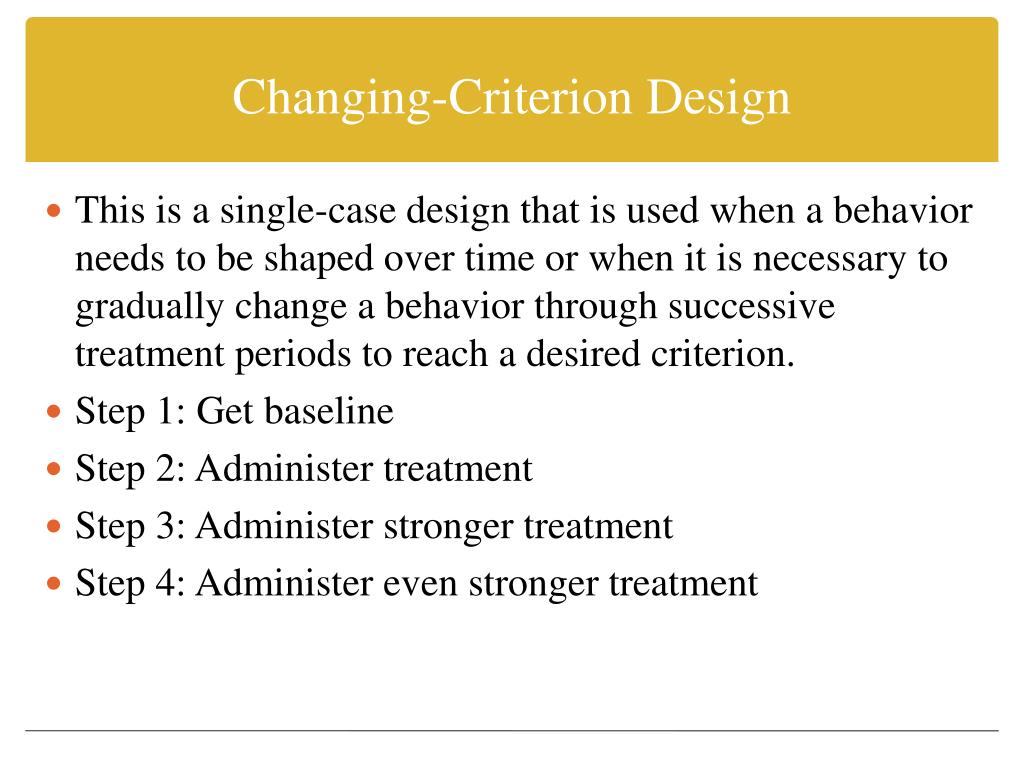
Each intervention was coded as having individual, group, both, or no contingency. Types of contingent reinforcement utilized were coded as token economy, tangible or activity, and or verbal praise. Punishments for not meeting criterions were recorded and classified as time-out, response cost (e.g., monetary, token removal), overcorrection, and follow-through. An experimental design in which an initial baseline phase is followed by a series of treatment phases consisting of successive, stepwise, and gradually changing criteria for which reinforcement or punishment is delivered, examining how these criteria impact responding.
ABA also helps transfer skills and behavior from one situation to another, controlling situations where negative behaviors arise and minimizing negative behaviors. With autism, ABA is most successful when intensely applied for more than 20 hours a week and prior to the age of 4. The CCD is somewhat inflexible in terms of variation due to the design features needed to achieve adequate control; however, basic variations within the classic structure which do not impact those features can be used such as the implementation of variable schedules of reinforcement or punishment. Reviewing the literature, the authors only noted three studies to implement this simple modification.
Further descriptions of these and other categories can be found in Appendix 2. Instead, their selected articles were screened and added to the sample if they were not already included in the initial search. These additions were excluded from the publication date limitation, resulting in the inclusion of a number of studies outside of the initial search date range. Though some studies may be restricted in their ability to vary phase length or magnitude, the relatively low number of studies implementing variations was unexpected. As mentioned, the CCD is one of the least experimentally strong designs in single case research and therefore exclusion of the components that increase its validity is counterintuitive. Intervention strategies other than reinforcement and punishment were implemented in approximately 70.0 % of CCD interventions.
A total of eight studies (4.9 %) reported participant involvement in setting criterions (i.e., goal-setting). Studies containing a CCD were identified through a search of PsycINFO, ERIC, and PubMed databases using the key word changing criterion as well as articles referencing Hartmann and Hall (1976). The introduction and discussion section of each article was examined to locate other studies utilizing a CCD. Articles containing both original research data and a statement that a CCD was used were included in this study.
This section of study records was further divided into discrete records wherever more than two variables were compared, for a total of 307 comparison records, which were then coded for outcomes. In this case, coding included which category of comparison was studied, and indicated whether one ABA method performed better, or if the results were mixed or had no change. At its core, ABA is the practice of utilizing the psychological principles of learning theory to enact change on the behaviors seen commonly in individuals diagnosed with ASD (Lovaas et al., 1974). F. Skinner’s theory of operant conditioning in the 1970s to help treat children diagnosed with ASD (or “autism” at the time) with the goal of altering their behaviors to improve their social interactions (Lovaas et al., 1973; Skinner, 1953; Smith & Eikeseth, 2011). To evaluate this method, the University of California at Los Angeles (UCLA) Young Autism Project model was developed and empirically tested by measuring the effects of the intervention when administered one-to-one to children diagnosed with ASD for 40 hr per week over the span of 2–3 years (Lovaas, 1987). The remarkable findings revealed that 47% of the children who participated in this treatment reached normal intellectual and educational functioning compared to only 2% of a control group (Lovaas, 1987).
The mean inter-rater agreement was 98.2 % (range, 93.2 to 100 %) across cases. The settings where the CCD was applied were classified as school, clinic or hospital, home, work, other institution, across multiple settings, or not reported. Discussion/General Information, Definitions, References and Index sections updated. There is no published literature demonstrating a benefit of ABT for conditions other than ASD and there are no clinical practice guidelines recommending ABT for non-ASD indications. Cognitive, developmental or intelligence quotient (IQ) testing is not required for an initial or continued course of ABT treatment to be covered.
For example, in teaching speech skills, one unit may be devoted to producing the vocal sound S. The therapist will typically ask for the desired behavior, reward the correct response, and repeat the process until the sound is produced spontaneously. DTT may be used for teaching communication skills, social skills, motor skills like writing letters of the alphabet. Any researcher, in the course of investigating the effects of a particular set of independent variables, must demonstrate that the observed changes in behavior are functionally related to the presence of those variables.




No comments:
Post a Comment